Confirmed > 99% Lab-grade Peptides
These can be specifically troublesome since their chromatographic habits is really similar to the target peptide, making them more challenging to divide throughout purification. When a peptide is 98% pure, that continuing to be 2% isn't random sound-- it specifies, identifiable kinds of byproducts. Mass spectrometry measures the molecular weight of a substance with severe accuracy. For peptides, one of the most usual methods are electrospray ionization (ESI-MS) and matrix-assisted laser desorption/ionization time-of-flight (MALDI-TOF). HPLC divides a mixture into its specific parts based upon how each molecule communicates with a particularly developed column.- Documents testimonial asks whether the record is batch-specific, traceable, and outlined sufficient to be investigated.The pureness of peptides is typically checked using high-performance fluid chromatography (HPLC).We give all the technical details and directions for each action of peptide synthesis and analysis.When you see peptides advertised as "research-grade," it describes their meant usage and the level of producing oversight.
Sample Prep Work
Many peptide distributors and research labs rely on a number of well-established logical approaches. All items are sold for study, research laboratory, or logical purposes just, and are not for human usage. Product summaries and categorizations do not indicate any kind of restorative outcomes. At Chameleon Peptides, every product ships with extensive third-party screening paperwork. You can discover more regarding our analytical screening procedures on our testing and top quality page. A 2016 survey released in Nature discovered that greater than 70% of scientists had attempted and fallen short to reproduce one more researcher's experiments.
The injector presents a precise volume of sample right into the mobile-phase stream. Constant shot quantity issues because overwhelming the column can widen tops, misshape pureness price quotes, or conceal neighboring contaminations. A strong peptide screening operations utilizes methods that answer complementary questions. The table listed below is the sensible method to think of common tests when checking out a peptide COA.
Research Study Uses Of Peptide Chemical & Physical Evaluations
For researchers, acquiring confirmed peptides isn't simply a rule-- it's the structure of reputable experiments and study reproducibility. Poor-quality peptides (those with unnoticed pollutants, wrong sequences, or deteriorated components) can result in misleading data and irreproducible results. In fact, proteins and peptides are among one of the most commonly used lab reagents, yet researches have revealed that their quality is typically poor, resulting in poor information reproducibility. Starting with proper laboratory recognition is as a result a crucial part of a researcher's quality control process.
This level of extensive analysis makes certain the peptide's accuracy-- meaning the sequence and pureness are precisely as identified-- which is vital for experimental reproducibility. By verifying make-up with multiple validated methods, research laboratory recognition assurances that researchers obtain a high-purity peptide that will execute as anticipated in the laboratory. Lab recognition of peptides is not only a scientific ideal technique-- it's typically a regulatory need when peptides are made use of in healing advancement Click for info or professional study.Stability Evaluation
FDA and the European EMA have developed standards mandating extensive evaluation and quality assurance for peptide products to make sure safety and effectivenessr. In the context of pharmaceutical or clinical-grade peptides, lab recognition is integral to meeting these standards. As an example, prior to a peptide medication can enter human trials, its maker should demonstrate the identity, purity, potency, and security of the peptide with verified logical techniques. Peptide get more info purity testing information are necessary in preclinical studies and need to be consisted of in investigational brand-new medication (IND) applications and later on new medication applications (NDAs).
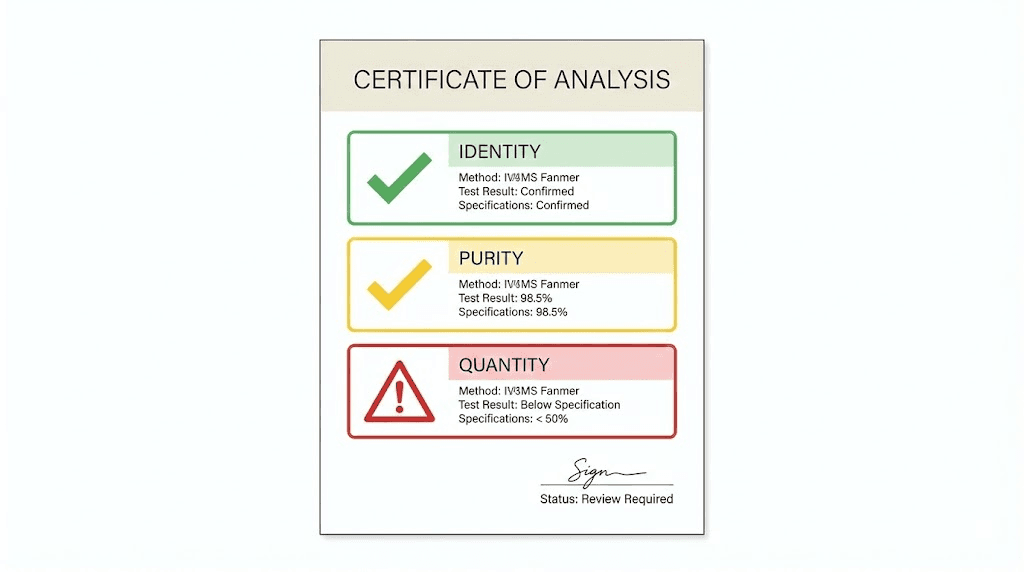
Peptide testing is the collection of analytical checks made use of to evaluate a peptide example before it is used in a study workflow. In sensible COA evaluation, the term normally refers to pureness testing, identification testing, and documents evaluation. Purity screening asks how much of the spotted example is the primary peptide versus relevant pollutants. Identification testing asks whether the determined mass or sequence-related proof matches the desired peptide. Documents testimonial asks whether the report is batch-specific, traceable, and described sufficient to be examined. Peptide screening is the analytical procedure made use of to verify that a research study peptide is both pure and appropriately determined.
A sample could produce a clean-looking chromatogram with one leading height and still be the wrong compound if identity was never ever verified. HPLC measures splitting up and family member peak location; mass spectrometry measures mass-to-charge behavior that can be utilized to confirm molecular identification. Peptide purity testing is the procedure of confirming that a peptide example includes just the desired sequence-- and no significant contaminants or results from synthesis. Because peptides are developed through complicated chemical procedures, trace contaminations can develop normally. Checking permits scientists to comprehend precisely what remains in the vial, validating both identification and high quality. Choosing a respectable third-party laboratory is key to obtaining trustworthy peptide recognition results.